
Food & Climate
No country wants to buy U.S. beef, while Washington consumers are increasingly demanding Australian beef, pushing global prices to record highs last July.
The FAO Meat Price Index averaged 127.3 points in July, up 1.5 points (1.2 percent) from June and 7.3 points (6.0 percent) from July 2024, and reaching a new all-time high.
The increase was primarily driven by higher bovine and ovine meat prices, along a slight increase in poultry meat quotations, while pig meat prices declined.
Global bovine meat prices reached a new record high, supported by higher quotations in Australia, underpinned by strong import demand, particularly from China and the United States of America, which outpaced available export supplies.
Robust global demand also contributed to firmer prices in Brazil. Ovine meat prices increased markedly for the fourth consecutive month, reflecting limited export supplies from Oceania amid sustained global demand, according to the statement that “Food & Climate” platform received on Friday.
Mad Cow Disease
In April, Donald Trump did not impose any special penalties on Australia beyond a baseline 10% tariff on goods exported to the US.
But Trump did single out the Australian beef industry in his speech preceding his tariffs announcement. “Australia bans – and they’re wonderful people – but they ban U.S. beef,” the US president said.
The US, Trump said, imported $3bn of Australian beef “last year alone”. He then took aim at Australia’s biosecurity rules restricting import of US beef.
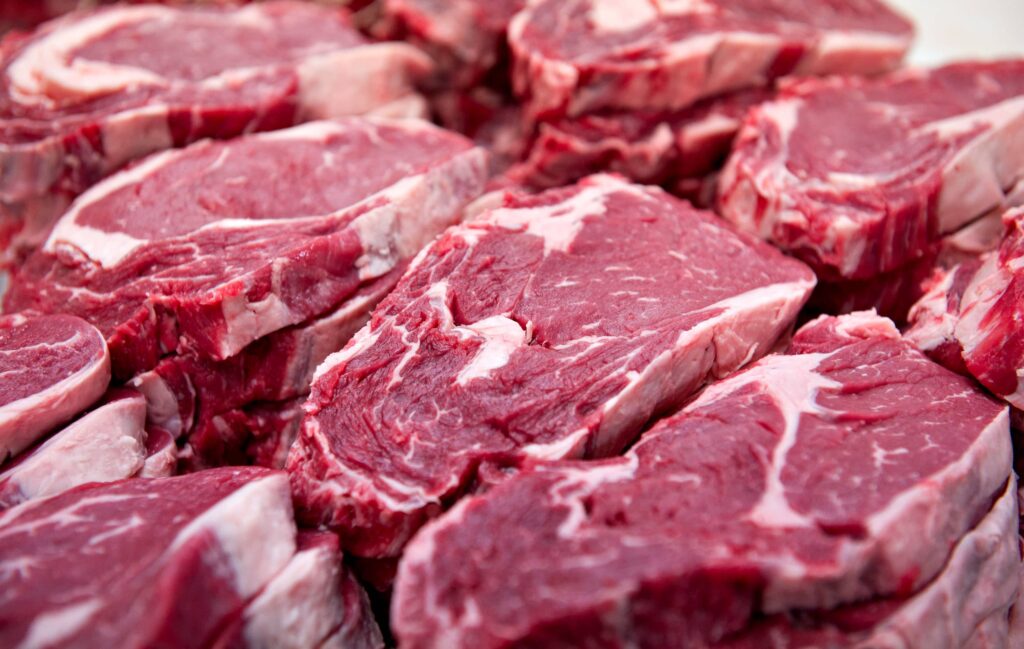
“They won’t take any of our beef. They don’t want it because they don’t want it to affect their farmers and, you know, I don’t blame them, but we’re doing the same thing right now”, according to “The Guardian“.
His administration also singled out the UK and EU for “non-science-based” restrictions on importing US beef, and Argentina for its ban of live US cattle exports.
Trump has used these import bans as part of his rationale to impose new trade tariffs.
There are different reasons why Australia, Argentina, the European Union and the United Kingdom don’t import some U.S. beef products.
They are related to BSE disease or Mad Cow Disease, and the U.S. cattle industry sometimes uses growth hormones to increase meat and milk yields.
The restrictions date on U.S. beef back to 2003
For Australia and Argentina, the restrictions date on U.S. beef back to 2003 when bovine spongiform encephalopathy (BSE) was detected in US cattle.
Humans can become infected with the disease when they eat meat contaminated with BSE. Globally, a total of 233 people have died from Creutzfeldt-Jakob disease after eating BSE-infected meat.
U.S. health authorities reduced the spread of BSE among US cattle sufficiently to see the ban on beef exports to Australia lifted in 2019.
But US imports are still restricted if they don’t meet Australia’s strict biosecurity laws. For US beef to be allowed into Australia, US cattle farmers must prove their cattle are entirely bred, grown and slaughtered in the U.S.
Argentina lifted its BSE ban on American beef products in 2018 but has maintained the restriction on live cattle imports until the two countries finalize a new “sanitary certificate”.
The EU and UK have restricted US beef imports since 1989 because the US cattle industry sometimes uses growth hormones to increase meat and milk yields. The EU does import non-hormone-treated beef from the US.
U.S. dairy and cattle farmers routinely use hormones like estradiol 17ß and testosterone to promote faster growth and improve feed efficiency.
The EU’s ban rationale, which is also maintained by the UK post-Brexit, is based on its own scientific evaluation showing that daily intake of growth hormones can have negative health impacts, including evidence that estradiol 17ß can cause cancerous tumor growth.
The US cattle industry has argued against the EU’s restrictions, saying food safety testing in the US shows no risk to adult health.
“[However], the European perspective is that the entire population does not consist only of health adults, but [also] of infants, children, the elderly, the immunologically compromised,” said Erik Millstone, an expert in food and science policy at the University of Sussex, UK.
The US has also criticized EU bans on importing US poultry that has been cleaned in chlorine.
U.S. poultry farmers wash poultry meat in chlorine solutions to kill harmful bacteria such as campylobacter, which commonly causes food poisoning, according to “DW”.