

Food & Climate
Beyond Meat is back in the spotlight. The plant-based meat company has seen a sharp rise in its share price after announcing a major U.S. retail expansion.
It revealed that its products would now be sold in more than 2,000 Walmart stores. The company also launched a new Beyond Burger 6-Pack, giving shoppers a more affordable way to buy plant-based meat.
But this comeback is about more than business. Beyond Meat’s biggest story lies in its climate and sustainability record, which continues to set it apart from traditional meat producers, according to a report seen by “Food & Climate” platform.
Beyond Meat’s stock surge surprised both analysts and investors. The sharp jump came after months of slow trading and declining confidence in plant-based food stocks.
Over a three-day trading period, Beyond Meat experienced a remarkable surge of nearly 600%, with its share price increasing from $0.52 on October 16 to a peak of $3.62 on October 21. By October 27, the stock had settled at $1.81, reflecting ongoing volatility and heightened market interest.
Beyond Meat’s growth strategy
Analysts say the rally reflects renewed trust in Beyond Meat’s growth strategy, especially its partnership with Walmart and the introduction of lower-priced products. The move shows how the company plans to reach more households and expand in a challenging grocery market.
Market data show Beyond Meat’s market capitalization climbed by billions of dollars in less than a week. The rally also sparked fresh interest from institutional investors looking at sustainability-driven food companies.
Even after the rapid rise, analysts note that Beyond Meat remains a volatile stock. Still, its recovery highlights how strong sustainability credentials and affordable innovation can reignite investor enthusiasm.
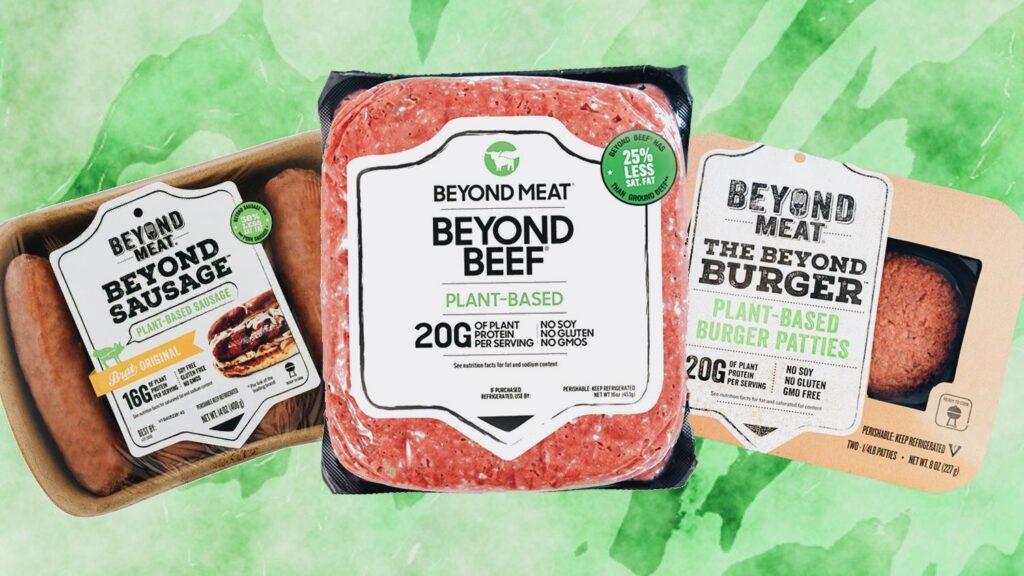
Beyond Meat’s latest life cycle assessments (LCAs) show how much cleaner its products are compared to beef.
Making a Beyond Burger creates 90% fewer greenhouse gas emissions than a beef burger of the same size.
It uses 97% less water, 93–97% less land, and up to 65% less energy.
One Beyond Burger has a carbon footprint of 0.68 kilograms of CO₂e, about 38 times smaller than beef.
These results come from studies done by the University of Michigan and reviewed by independent experts. The reason for the low impact is simple.
Beyond Meat’s ingredients — such as peas, rice, and canola — take far fewer resources to grow than raising cattle. Cows also release methane, a gas far more powerful than CO₂, which plants do not produce.
Beyond Meat’s new Beyond Steak also shows strong environmental performance. The product emits 84% less greenhouse gas and uses 93% less water than a beef steak.
The company says if every American swapped one beef meal a week for a Beyond Meat product, it could cut emissions equal to taking 12 million cars off the road each year.
Food production greenhouse gas emissions
Food production creates about 1/3 of global greenhouse gas emissions, according to the United Nations. Plant-based meat helps lower that total, making a diet change one of the fastest ways to fight climate change.
Beyond Meat’s commitment to sustainability goes beyond its products. The company’s ESG plan focuses on clean operations, better packaging, and responsible sourcing.
In its latest ESG report, Beyond Meat said it had cut its operational carbon footprint by over 20% in just two years. Its total GHG emissions reached about 193,700 metric tons of CO₂e across all scopes. This includes 7,999 tCO₂e from Scope 1, 9,065 tCO₂e from Scope 2 (market-based), and 176,654 tCO₂e from Scope 3 activities such as purchased goods and services.

Beyond Meat’s model supports the Paris Agreement’s goal to limit global warming to 1.5°C. Livestock farming creates nearly 15% of global emissions, mostly from methane. Replacing even part of the global meat market with alternatives would have a big impact.
Analysts at Boston Consulting Group (BCG) estimate that if 10% of all meat sold by 2030 were plant-based, it could cut 0.5 gigatons of CO₂e each year.
By expanding through Walmart, Target, and other retailers, Beyond Meat is helping make climate-friendly food more common and affordable.
Beyond Meat’s recent recovery also matches a growing global market for sustainable food. Plant-based food sales hit $52 billion in 2024 and could reach over $160 billion by 2030, according to Bloomberg Intelligence.