
Food & Climate
Food waste in South Korea has been continuing for far longer than most countries after its main landfills reached capacity in the early 1990s. But now it becomes biogas powers and chicken feed.
The crisis prompted big overhaul of the system and a nationwide pay-as-you-throw scheme in 1995.
Residents were required to buy official rubbish bags, which reduced waste but also produced an unexpected issue: once recyclables such as paper were separated out, food scraps were left sitting wet in general waste, worsening odour problems.
The practice of sending food to landfill was banned altogether in 2005, and mandatory separation imposed. Collection methods varied in the early years, but standardisation accelerated after 2013 when the ocean dumping of leachate – the liquid from food waste processing – was banned, forcing it to be processed on land.
Most areas used prepaid yellow bags, which encouraged frugality but created inconveniences: bags filled slowly, especially for small households, and residents disliked storing smelly waste during humid summers, according to a report seen by Food & Climate.
RFID bins use to solve food waste in South Korea
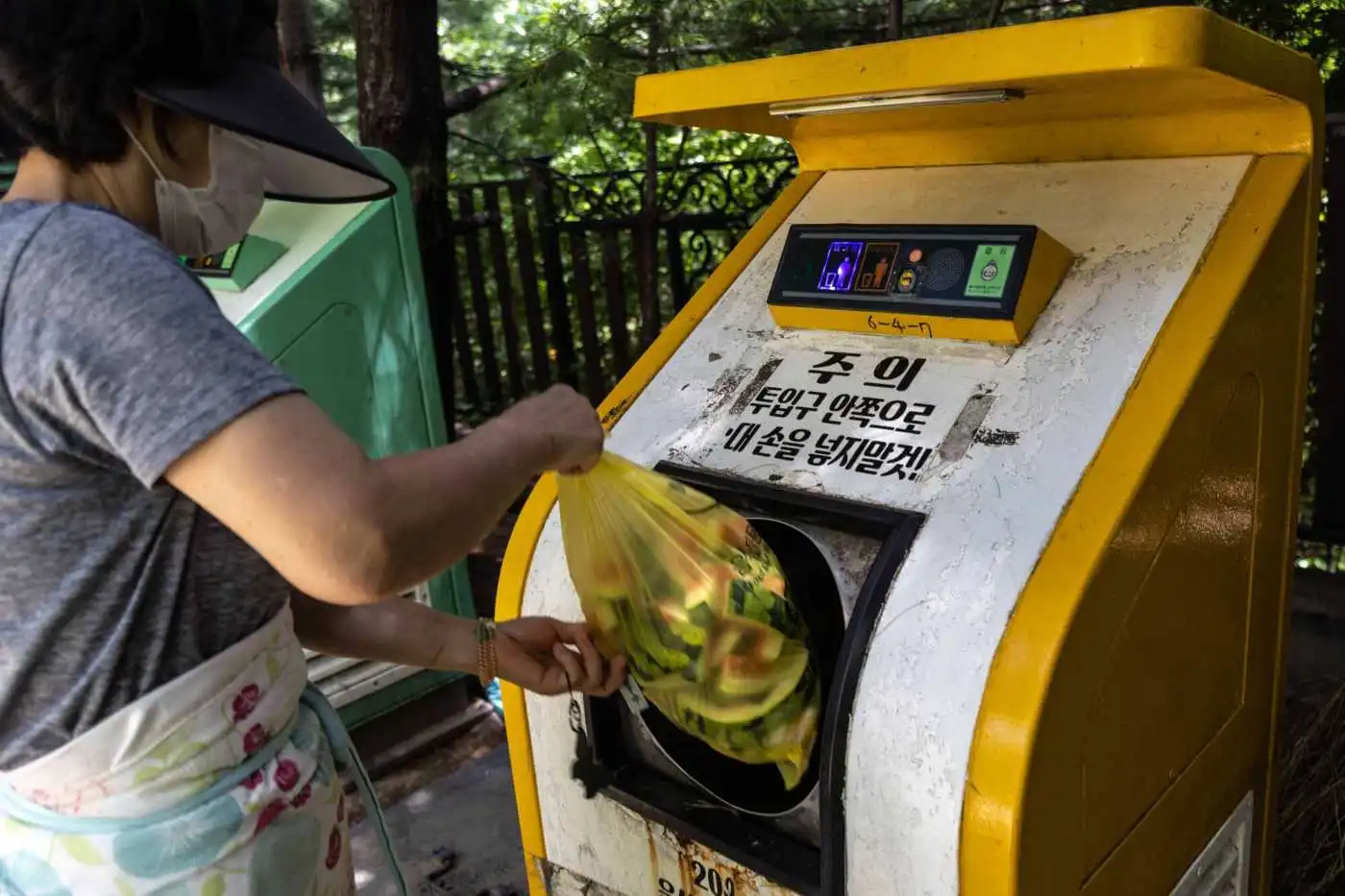
To address the problem of food waste in South Korea, it was introduced RFID bins, designed to make disposal both more precise and more transparent, were introduced in the early 2010s and are now widespread across cities. The fee – 130 won (about 7p) a kilo in Seoul – is automatically added to monthly maintenance bills.
The system changed behavior at home. Every household has its own method for squeezing out moisture.
“If you don’t remove water, it gets expensive. People press it, drain it and even use strainers. You learn your own tricks”, says Min, who has lived in the complex for 15 years and watched the system arrive in 2020.

Being able to dispose of small amounts several times a day also means she no longer worries about smells or flies. “It’s just more convenient,” she says. “I can come here anytime.”
Seoul operates 27,289 RFID units, serving 81.6% of apartment residents. Overall coverage across all housing types stands at 37.9%. Nationally, 150,738 units serve 8.54 million apartment households across 186 of the country’s 229 municipalities.
The shift has produced measurable results: since citywide implementation began in 2013, Seoul’s food waste has fallen by 23.9% in a decade, from 3,181 tonnes a day to 2,419.
Minimise odor complaints
Studies of individual complexes show even steeper drops. Research across five Seoul apartment blocks found average reductions of 51% once residents could see – and pay for – the exact weight of what they threw away. In Siheung, a city south of Seoul, officials report a 41% cut across buildings that have adopted the technology.
From the bins, the waste – which amounts to about 300 tonnes a day from East Seoul – is taken to the Gangdong district resource circulation center, where the processing machinery is built underground to minimise odour complaints. Incoming waste is shredded, and foreign materials such as metal fragments or onion mesh bags extracted before the waste moves deeper into the system.
It is then pressed to extract water, and the separated liquid feeds into anaerobic digesters.
The resulting biogas powers the facility’s drying process and odour control systems. The remaining solids – about 10% of the original volume – are dried, screened again for contaminants, and processed into chicken feed that is sold nationwide and even exported. National figures show that around 42% of recycled food waste becomes animal feed, 33% compost and 16% biogas.
It has an impact in people’s kitchens too. For many families, Min says, the digital display above the bin has made portion control part of daily life. “If the family leaves food, I make less next time.
You start thinking differently.” Cultural norms and regulations reinforce the habit, and community bulletin boards regularly remind residents of sorting rules. “People here are used to doing things properly,” she says.

Despite its success, the programme faces several challenges. Central government funding for installation ended in 2014, which means local authorities must finance any new machines themselves.
Smaller or poorer municipalities have struggled to keep up, and several have reported delays or slower uptake because of budget constraints. Earlier generations of machines have also suffered from corrosion from the high salt content of Korean food, adding to replacement and maintenance costs, according to “The Guardian” .